

 Department of Health and Human Services

NC Department of Health and Human Services
|

Sulfuric Acid Releases in North Carolina
The information in this report was collected by staff in the North Carolina Hazardous Substances Emergency Events Surveillance (HSEES) Program. Sulfuric acid releases in North Carolina have resulted in injuries, hospitalizations, and workplace evacuations (Table 1). Some examples of sulfuric acid releases in NC include:
- An employee of a janitorial supply store was filling an overhead storage tank with a bucket of sulfuric acid when the ladder slipped, causing him to spill five gallons of acid on his body. He was admitted to the hospital with second-degree chemical burns over 40% of his body.
- Employees who were trying to clear a drain mixed sulfuric acid and bleach, causing a chemical reaction. The gas released caused respiratory irritation, eye irritation and nausea to the employees. They received treatment at the scene from Emergency Medical Services personnel
- A professional firefighter in turnout gear suffered respiratory irritation while extinguishing a fire of automotive batteries in a trailer. He was treated at the hospital.
- An overcharged battery burst at a retail auto parts store. One employee was transported to and treated at the hospital for respiratory irritation.
- Drain cleaner containing sulfuric acid was spilled at a daycare. Sixty-eight children and faculty were evacuated for one hour. One employee was treated at the hospital for respiratory irritation
- A chemist, mixing 96% sulfuric acid, cracked the beaker. He was using gloves and eye protection but was still chemically burned and required treatment at a hospital.
Of the 58 sulfuric acid releases or threatened releases that occurred between 1993 and 1998 in North Carolina, 40 (69%) occurred in fixed facilities and 18 (31%) took place in transit. Most of the fixed-facility events resulted from unintended releases from above-ground storage (N=14, 30.4%), piping (N=10, 22%), and material handling (N=7, 15%).
Efforts to identify the factors contributing to chemical releases were initiated in mid-1995. Since then, equipment failure has been cited as the major contributing factor, responsible for 56% (10) of the 18 sulfuric acid events for which this information is available.
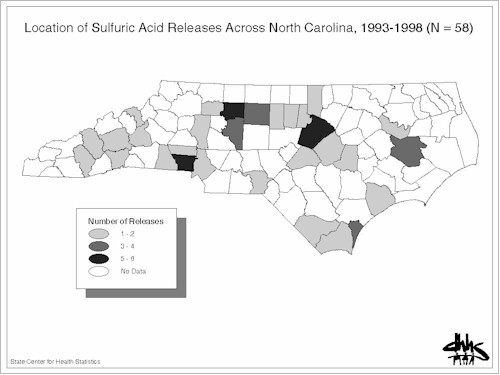
The 58 events occurring between 1993 and 1998 are summarized in Table 1. Table 2 lists the types of industries involved in sulfuric acid releases. Locations of sulfuric acid releases are shown in Map 1.
| Data | Number | |
|---|---|---|
| Number of sulfuric acid releases | ||
| Actual releases | 56 | |
| Threatened releases | 2 | |
| Total | 58 | |
| Number of events involving victims | 12 | |
| Number of victims | 15 | |
| Types of injuries (victims may report more than one injury) | ||
| Respiratory irritation | 4 | |
| Gastrointestinal problems | 1 | |
| Chemical burns | 5 | |
| Eye irritation | 1 | |
| Other | 1 | |
| Trauma | 5 | |
| Total: | 16 | |
| Range of amounts released (pounds) | 1 to 21,260 | |
| Type of sulfuric acid release (may have more than one type/ event) | ||
| Spill | 53 | |
| Air release | 4 | |
| Fire | 2 | |
| Events with decontamination | 12 | |
| No. of events with responders decontaminated | 4 | |
| No. of events with employees decontaminated | 8 | |
| Events requiring evacuation | 6 | |
| Number of events following a contingency/ preparedness plan | 57 | |
| Type of response | ||
| SARA | 1 | |
| HAZMAT/ response team's standard operating procedure | 34 | |
| Company's operating procedures | 10 | |
| Incident Specific | 1 | |
| Other | 3 | |
| Unknown | 9 | |
| Total | 58 | |
| Type of NC Industry Releasing Sulfuric Acid | Number of Events | Percentages |
|---|---|---|
| Trucking Services | 15 | 25.9 |
| Manufacuring - Petroleum refining | 6 | 10.3 |
| Manufacuring - Drugs, chemicals, and allied products | 3 | 5.2 |
| Retail auto & home supply stores | 3 | 5.2 |
| Other | 31 | 53.4 |
| Total | 58 | 100 |
Map 1: Location of Sulfuric Acid Releases across North Carolina, 1993-1999 (N=55)
Common Routes of Sulfuric Acid Exposure
- Inhalation. The most common way for sulfuric acid to enter the body is through the respiratory system. Serious lung damage may result from inhalation exposure to sulfuric acid.
- Contact with the Skin. Sulfuric acid can irritate the skin and cause chemical burns ranging from mild to severe, depending on the concentration of the sulfuric acid solution. Concentrated vapor or solution that contacts the skin may cause the victim to experience severe pain, redness of the skin, blisters and necrosis.
- Contact with the Eyes. Sulfuric acid or sulfuric acid vapor, even with short-term exposure, can irritate the eyes and cause burning, swelling, tearing of the eyes and/or blurred vision, and may cause blindness.
- Ingestion. Immediate burning in the mouth and throat occur when sulfuric acid is swallowed. Ingestion of concentrated solution can cause severe pain in the mouth, chest and abdomen, nausea and vomiting, or perforations in the esophagus.
Acute Health Effects of Sulfuric Acid Exposures
As the concentration of sulfuric acid increases, the symptoms become more severe. Acute exposures to sulfuric acid can cause immediate burning of the eyes. Itchy, burning eyes can help to warn people of potentially hazardous exposure levels. The very young, the very old, and people with health problems are at an increased risk from the health effects of sulfuric acid exposure.
Chronic Health Effects of Repeated Exposure to Sulfuric Acid
Erosion of the teeth, stomatitis, gastric strictures, chronic bronchial irritation with cough, and/or chronic shortness of breath may occur with repeated or long-term exposure to sulfuric acid. Skin rashes may also occur with repeated exposures of dilute concentrations of sulfuric acid.
Proper Handling and Storage Procedures
Before working with sulfuric acid, individuals should be trained in its proper handling and storage and know how to use proper personal protective equipment.
Sulfuric acid should be stored in a cool, dry, well-ventilated area in tightly sealed containers protected from exposure to weather, extreme temperature changes, and physical damage. Sulfuric acid is incompatible with organic materials and metals. Contact with either of these materials could cause fire and explosions, or generation of toxic sulfur dioxide fumes and flammable hydrogen gas.
If a fire occurs in the immediate vicinity of sulfuric acid containers, remove them promptly if it can be done safely. If removal is not possible, use dry chemical or carbon dioxide to extinguish the fire for small fires. For large fires, flood the fire area with water from a safe distance. When water is applied directly to sulfuric acid, heat evolves and spattering may occur. When heated, sulfuric acid emits highly toxic fumes, so firefighters should use positive-pressure breathing apparatus.
Personal Protective Equipment
- Clothing
Avoid skin contact with sulfuric acid. Wear chemical-resistant clothing and protective gloves. Nitrile and natural rubber gloves are best suited for prolonged contact with sulfuric acid, but vinyl gloves are also acceptable. Check with glove manufacturer for recommended use and duration guidelines. - Eye Protection
Employees should use splash-proof goggles when there is any possibility of sulfuric acid exposure. An eye-wash fountain or an eye wash kit for emergency responders should be available if there is any possibility of the eyes coming in contact with a solution or liquid sulfuric acid with more than 1% sulfuric acid by weight. - Respiratory Protection (respirators)
Engineering controls should be implemented to reduce environmental concentrations to the permissible exposure level (1 mg/m3). Respirators should be used when engineering and work practice controls are not feasible or are being installed. Respiratory protection should be approved by NIOSH specifically for sulfuric acid and used in accordance with the OSHA Respiratory Protection Standard, 29 CFR (Code of Federal Regulations) 1910.134. Under routine exposures where the ambient concentration of sulfuric acid exceeds 1 mg/m3, use an air purifying, full-face respirator equipped with acid gas cartridges appropriate for sulfuric acid. For exposures of unknown concentrations of sulfuric acid, such as uncontrolled releases, only a pressure-demand SCBA (self-contained breathing apparatus) is appropriate. Respirator use must be limited to individuals who have been medically cleared, adequately trained, and fitted for the respirator face-piece. Companies are also referred to 29 CFR 1910.119, Process Safety Management of Highly Hazardous Chemicals Standard, for additional information.
First Aid Management
Prompt action is essential if there is a sulfuric acid spill or leak. If a sulfuric acid spill or leak occurs, take the following actions:
- Breathing
If sulfuric acid is inhaled, move the person to fresh air at once. If breathing stops, perform artificial respiration. Keep the affected person warm and resting. Seek medical attention immediately. - Eye Exposure
Wash eyes immediately with large amounts of water for at least 15 minutes, lifting the upper and lower lids. Seek medical attention immediately. Contact lenses should not be worn when working with sulfuric acid. - Skin Exposure
Skin contaminated with sulfuric acid should be flushed with soap and water for at least 15 minutes. Do not scrub or rub skin. If strong concentrations of gas or solution penetrate clothing, remove clothing and flush the skin with water. Seek medical attention immediately. - Swallowing
If sulfuric acid solution is swallowed, and the person is conscious, give him large amounts of water or milk to dilute the sulfuric acid solution. Do not attempt to make the exposed person vomit. Seek medical attention immediately. Refer to a material safety data sheet (MSDS); call the poison control center (1-800-848-6946), or call a physician.
Spill Management
If a sulfuric acid spill or leak occurs, take the following actions:
- Notify trained personnel immediately, such as the company HAZMAT team or the local fire department. Untrained persons or those without proper personal protective equipment must not enter areas with high concentrations of sulfuric acid.
- Evacuate and restrict people from the hazardous area of a sulfuric acid release.
- Stop or control the source of exposure.
- Ventilate contaminated atmospheres by opening windows to disperse the fumes.
- If the exposure is from the spill of a solution, collect or confine the spilled material. Dilute and neutralize the spill and dispose in a secured landfill. Sulfuric acid may be absorbed in vermiculite, dry sand, or similar material.
- Refer to the manufacturer's Material Safety Data Sheet (MSDS) for more information about sulfuric acid hazards.
NC HSEES Program
The North Carolina Department of Health and Human Services - Division of Public Health studies and describes the public health effects associated with releases of hazardous substances, such as sulfuric acid, as part of the Agency for Toxic Substances and Disease Registry's (ATSDR) Hazardous Substances Emergency Events Surveillance (HSEES) system. North Carolina is one of 16 participating states. Data are analyzed to determine trends and areas for prevention. The information is then used to develop ways to protect health and prevent or minimize hazardous substance releases.
The HSEES staff is notified about spills by several sources. The primary sources of information are the N.C. Division of Emergency Management, the U.S. Coast Guard's National Response Center, and the U.S. Department of Transportation's Hazardous Materials Information System (HMIS). To gather specific information about each spill, staff contact local emergency management personnel, fire department personnel, emergency medical personnel, and/or industry representatives.
To plan appropriate prevention strategies, we rely on accurate and timely reporting. If you are contacted about a hazardous chemical spill, please answer the questions as precisely and accurately as possible. The information you provide is critical to preventing future spills and reducing the risk of injury to employees, responders and the public.
Resources and Information
- Occupational Safety and
Health Administration (OSHA)
OSHA provides specific information about proper handling, storage, and safety and health management of sulfuric acid. Publications can be obtained by written request or through the OSHA web page.
OSHA Publications Office,
200 Constitution Avenue NW
Room N3101
Washington, DC 20210
(202) 219-4667
See their web site for specific sulfuric acid information.
North Carolina OSHA
4 West Edenton St.
Raleigh, NC 27601
(919) 807-2860
- National
Institute of Occupational Safety and Health (NIOSH)
NIOSH Publications
4676 Columbus parkway, Mail Stop C-13
Cincinnati, OH 45226-1998
1-800-35-NIOSH (1-800-356-4674) - Environmental Protection
Agency (EPA)
Ariel Rios Building
1200 Pennsylvania Avenue, NW
Washington, DC 20460
202-260-2090
Region IV EPA (includes North Carolina)
Atlanta Federal Building
61 Forsyth Street, SW
Atlanta, GA 30303-3104
404-562-9900
1-800-241-1754
- North Carolina HSEES
Program
Occupational and Environmental Epidemiology Branch
HSEES Program
1912 Mail Service Center
Raleigh, NC 27699-1912
Location:
5505 Six Forks Rd.
Raleigh, NC 27609
References
Burgess, William A. Recognition of Health Hazards in Industry A Review of Materials and Processes. 2nd ed. New York: John Wiley & Sons, Inc, 1995. 340-341.
US Department of Health, Education, and Welfare. Public Health Service, Centers for Disease Control, National Institute for Occupational Safety and Health. Occupational Diseases - A Guide to Their Recognition. Ed. Marcus M. Key, M. D., et al. Washington, D. C.: DHEW (NIOSH), 1978.
State of North Carolina - Beverly Eaves Perdue, Governor
Department of Health and Human Services - Lanier M. Cansler, Secretary
Division of Public Health
The NC Department of Health and Human Services does not discriminate on the basis of race, color, national origin, sex, religion, age or disability in employment or the provision of services.
Return to the Occupational Illnesses & Injuries homepage.
[
Topics A-Z |
Communicable Disease Control |
Exposure to Chemicals |
Environmental Contaminants ]
[ Fish Consumption Advisories |
HIV/STDs |
Hurricane Information |
Indoor Air Quality ]
[ Medical Evaluation & Risk Assessment |
Occupational & Environmental Epidemiology ]
[ Occupational Illness & Injury |
Ozone |
Pfiesteria ]
[ Rabies |
Tuberculosis |
Veterinary Public Health ]
[ North Carolina Department of Health and
Human Services ]
Page last updated on Thursday June 07 2012