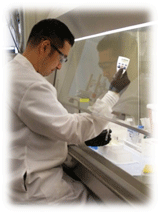
Created in 2002, as part of the Laboratory Response Network (LRN), to respond to chemical acts of terrorism by testing potentially exposed persons for cyanide and metals. The unit has expanded this role to currently respond to acts of terrorism, accidental exposures, occupational exposures, and the identification of unknown substances.
The CTAT is an enhanced level 2 laboratory participating in the Laboratory Response Network for chemical emergencies. As part of the network, the CTAT can respond to national events or assist other states to absorb surge testing.
The CTAT unit is staffed with four chemists. 24-hour continual operations are managed by rotating 2-person, 12 hour shifts throughout an event.
All clinical testing is conducted using Mass Spectrometry. Two ICP-MS (Inductively Coupled Plasma- Mass Spectrometer) instruments are employed for metals testing. Four GC-MS (Gas Chromatogram- Mass Spectrometer) instruments are used for testing Cyanide, Tetramine, Volatile Organic Compounds, and unknown substances. One HPLC-MS/MS (High Performance Liquid Chromatograph-Mass Spectrometer) and one QTOF (Quadrupole Time of Flight) instruments are used for the testing of exposure to Nerve Agents, Tetranitromethane, as well as Ricin and Abrin exposures. As well, FTIR (Fourier Transform Infrared) and Raman Spectroscopy are used to help identify unknown substances.
The Importance of CTAT
The only conclusive way to confirm exposure is to perform clinical testing.
The CTAT unit is a 24/7 response to chemical exposures ranging from accidental exposure to overt acts of terrorism.
The CTAT unit can identify or rule out chemicals in the testing of unknown substances such as white powders.
The CTAT unit provides national support for CDC and other states to perform surge testing.
The ability to respond after hours and respond quickly is designed into the unit.
The highly specific tests the CTAT unit routinely tests for are not available in any hospital or commercial laboratory.